Thursday, September 4, 2014

September roaring in like a lion?


So the July update never happened, and neither did the August, and here we are at September.  I have a few projects going on, and they all move slowly.

Little Penny turned 3 already in July, I turned 41, and Autumn started Kindergarten.  There have also been various work events, and derby things to get in the way.  Life, as always is busy.  I’m still sitting on gifts (now for CHRISTMAS and Birthdays) for my nephews too; I am a terrible person. 

So what do I have for a progress report:
1.       Bows and Archery
a.       I decided that SCB1 didn’t need to be a 70# monster.  So, I thinned it down a little bit, I haven’t scaled it, but I am guessing closer to 55# at this point.   It works pretty well with my Nice arrows, as does my Oak bow.  I just need to practice a lot more, on a less windy day.  And I need to work on an arm guard, since I am sick of having a mildly bruised wrist.

Update: I guess I should say “worked”, I broke both of the bows L  The Oak cracked in half, the salt cedar appeared to just crack at the fiberglass, but when I reglassed it, it cracked in the same places.  Better luck next time. 

b.      Salt Cedar Bow 2 (SCB2) was making progress, but stalled after breaking the others, I am letting it season a bit in the shed, and hoping that reduces its desire to crack.  Right now I am thinking I will try to make it more flat, like the oak bow.  We’ll see.  I think I will make it relatively thin, might layer something else over, like a modern laminate bow. Not sure at this point.

c.       In the meantime, Erica bought me a bow for my birthday.  It’s a Sammick Journey 66” takedown recurve.  I think that my 400 spine arrows are working pretty well. Not that I am a judge, but I seem to be able to hit the target most of the time at 30 yards.

2.       Forges and Knives
a.       In the forge I have also made some progress.  I am still  working on a 1095 Machete.  It looks pretty cool right now. I peened along the back edge – like the uncle Jed’s country skinner I made a while back.  I like the effect. All it really needs now is a handle.

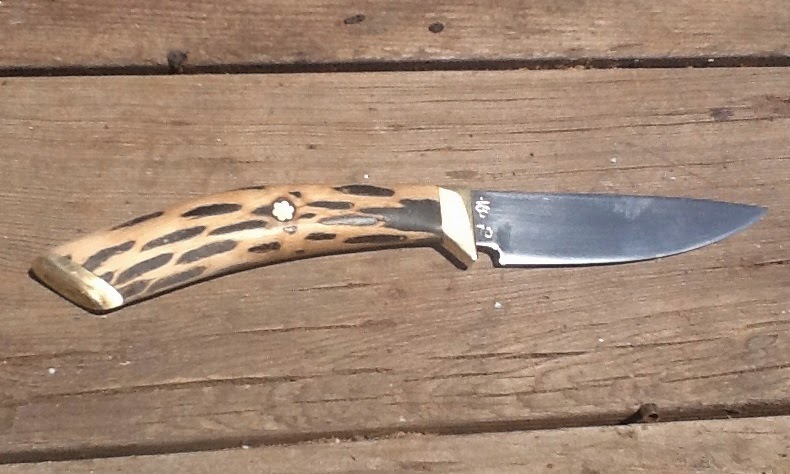
b.      And I also finished a nice little Wharncliffe EDC knife in a more modern style, despite the W2.  I went for a hamon of course, because they add interest value, but it wasn’t very impressive. 
Usually I quench and temper my knives before taking out all the scratches, which makes getting rid of them a severe challenge.  This time, I sanded the blade to 220 first, and it was MUCH EASIER to get the rest of the scratches out.

I picked up a variety of G10 handle material too.  If you follow my work at all, you probably know that I prefer working with natural materials.  I get the point of the modern stuff, but just think that wood is prettier.  So far I’ve made two plastic handles,  black canvas micarta, and white linen micarta. They both smell pretty bad when shaping the handles.  I haven’t worked with G10 yet, but I hope it doesn’t smell as bad.  I bought more military colors this time, Ghost green and sand, black and grey.  The EDC has a black and grey handle.

c.       9” Chefs Knife in 1084g is in progress.  When I joined the facebook group Cool Knives and Gear and posted pictures of my in stock knives, someone asked about a big chef’s knife, so I decided to make another one.  It’s coming along pretty well, just need to Normalise, harden and temper. 

d.      After talking about it forever, I finally started on my Navaja. Have the blade forged out, but am missing some of the folder hardware, and haven’t done any of the heat treat yet.  Still needs more holes too – I haven’t decided which order to do it all in yet.

e.   I also finished AR 81, a nice mid sized knife.  Blade is about 4 1/2, and 9 1/2 overall S35VN steel, Copper guard, Cocobolo handle with peened brass pins.


f.      And I sold a knife!  Haven’t done that in a while.  My moonstone dagger

3.       Turnings
a.       Honestly, I hadn’t touched the lathe in a while – at one point I decided I wanted to try to bore out a flute, but got distracted, and haven’t played with it since.  There are a few pen kits that I should still make, and a light pull, and couple other things that I have kits for, but motivation is low.
So I made three pens (and most of a 4th) and a light pull, this weekend.  None of them are very exciting, but they get the materials out of my shop.
b.      I have sold some things though which is pretty cool, a couple pens, a bowl, a light pull, the last full shaving set!


Monday, August 4, 2014

Arts, Crafts, and Mechanization

I don’t mean to offend any machinists, craftsmen, artists, hobbyists, or anyone else out there. Or to say that you can’t combine any or all of the catagories.  This is just a ramble of thoughts.

Most of the time I don’t consider myself to be an artist, or really even a craftsman, despite making knives, bows, bowls, pens, and a variety of other things.  I am a hobbyist or something like that.  I don’t focus on one particular topic, get bored easily with doing the same or even similar craft work, and therefore, rarely spend enough time on a particular craft to get very good at it.  I often feel like my first attempts at something are the best because I haven’t gotten bored with the particular task.  In my mind, Craftsmen are those who take the time to get better and better at a particular craft.  So what are artists? I think they are people who put a great deal of themselves into their work no matter the medium.

So what is my point today? I see a lot of mechanization in the field of knife making.  And those products tend to be cleaner and more precise than “handcrafted work”, and most importantly – repeatable as long as the materials and tools hold out.  I can’t do that as a hobby craftsman.  I can make something that looks pretty similar, but it won’t be the same. The hammer doesn’t fall in the same place, the grinder (or sandpaper) marks are different, the gluing shifted slightly, I  burned my finger, the heat treat was 25 degrees different.  I am not a machine.  So which is better? 

Neither. 

There is something to be said about the ability to repeatably make an item, once you get the design and set up out of the way (something that isn’t as easily done as said), and have the process for finishing put together, pieces and parts “just” need to be assembled (see children’s toy assembly for a simple vertion of “just”) and finished, not necessarily in that order.  Mistakes may happen, but generally, the process is repeatable.  Repeatability doesn’t mean that it isn’t art! But the art may be in the design, and assembly and finishing rather than in the machining. I don’t know, maybe there is a grey area.

There is also something to be said about raw crafting – and don’t get me wrong, I use plenty of tools, otherwise my hands would be burned bloody stumps and I still wouldn’t have a product. But at the same time, I rarely measure anything, everything is “by eye”, or until it feels right, or until it fits.  Yes, there is some rough marking of important points, but either I or my machines aren’t that precise most of the time.  I have – rarely – attempted to repeat a project, or make two of something, but inevitably, they are different.  I don’t know if the unrepeatability of my work (by me at least) makes them more artistic.  They generally don’t have the same level of fit and finish as a machined piece, and overall may not be the same “quality” but are they more because they are unique?  Perfect in their imperfection? 

Which would you rather have as a tool? Or as an object to set on your shelf and look at?  Does it make a difference?  Sometimes?  If I make a bowl on my lathe – for me a moderately repeatable task,  although there are likely to be slight variations in shape and size and thickness and symmetry.  I would still rather have that hand turned bowl on my shelf rather than a machine turned piece identical (except for the piece of wood) in all dimensions to 50 or a thousand others.  But a tool? A knife? Yes, there are machined knives that are beautiful, but if there are a thousand of them are they as beautiful? Why not? At the same time, the fit and finish and precision, and the ability to tweak the process to make them even better in future iterations, has a great deal of appeal.

If you want the “best” of something, the ability to tweak the design is key. Craftsmen can only achieve it over a great deal of time and practice (Apprentice, journeyman, master), and although there are certainly different skill levels of machinists also, specifications can be transmitted from one to another and the results should be pretty close. 

I’m sure that any Japanese swordsmith would cringe at the plethora of very functional machined katana out there, but is the hand forged, hand polished, version that much functionally better, or even more beautiful? What if you consider that one takes 10 or more times as much time to make?


I’m a bit jealous of the mechanized craftsmen, and I still want a power hammer, but I don’t think that I will stop being a hobby craftsman for now.

Tuesday, June 17, 2014

Salt Cedar Bow Update

Since I had a little spare time over the last week, I worked on Salt Cedar Bow 1 – 


There is still a bit of twist to the bow, but it doesn't seem to have much impact on performance, and it seems to make the the string line up almost as if it was a centerfire bow.

I didn’t really have a target weight in mind, so it ended up a little stiffer than I expected, probably around 70# at full draw.  And it appears to handle that without any trouble.

Again, I didn't do a fabulous job on the tillering, a bit softer on the right than the left.
I didn't measure the set, but it does hold onto some.
It’s relatively short, about 55” strung, but I think that it came together very nicely in the end. 


My arrows from Nice Archery came in this weekend also!  Naturally, I didn’t have time to try them out over the weekend, since my family just came home, and father’s day happened, and the next three days have predicted 20+ mph winds, but they look very pretty!  I’m sure they will be awesome.  It will be interesting to see how they do with Salt Cedar Bow 1.  

I had been playing with my one carbon fiber arrow and Autumn’s flimsy plastic ones, and it seemed a lot more accurate with the floppy pink ones J

I will have to make another one - good thing I have three more pieces.  I think about 50# will be my target for the next one.

Monday, June 9, 2014

And that's not all

In addition to working on the Salt Cedar bow this weekend, I spent some time on knives.

One of my co-workers asked me if I could make a machete, so I cut a big piece of 1095, and got started. 

Two forging sessions later
 
Its going to be a monster - If I remember right it started out at 21 inches (the Kindjal ended at 20), and its definately stretching a bit.  I need to mitigate the curve some too - it looks fancy, but doesn't feel right yet.

I put a handle on the Uncle Jeds Country Skinner MkII - its a pretty massive knife.  Still needs a bit of finishing on both the handle and blade. Honey Locust handle, with a wrought iron guard.

As promised, AR70 got a brass pommel.  Which still needs polishing... and the handle needs re-finishing.

 This little utility blade is also pretty old,  but now that my carbide bits came in I can punch holes in metal again.  Still needs a lot of finish work, but at least it looks like a knife now.  No idea what they handle is made of -that's the problem with trying lots of different woods - they don't stay labeled long enough.

And this is the revised Kershaw Antelope II - it had broken off in the handle, so i had to grind down the blade to get enough tang to hold the blade in place, and I like my handle better anyway :)  I'll polish up the blade a little bit more too. Katalox handle.

Here they are together for better sense of scale. 

I made this little S35VN stainless steel blade a while back, but never got around to it, but it came together nicely yesterday - just needs its mark, and it will be finished.  Looks like it was in 2011 - my how time flies.
Its got an Amaranth (Purpleheart) Handle with Raaen pins, Nickle Silver Accents and an antler piece as well.

Fancy!


Salt Cedar Bow

As a new bow maker, I wouldn’t call myself a bowyer, I certainly don’t have any experience, or much other than basic woodworking skills, and who has relatively successfully made all of one bow, I immediately did some research on what people thought about different woods.  Everyone seems to think that Osage is great, Yew is great, and lots of other will make a serviceable tool, or that lots of others are awful. 

Looking around for quantification I came across this article at the Wood Database –

In the article, the author (who, like me, isn’t a bowyer or materials scientist) came up with a formula that he thought might estimate the quality of the wood for making bows. I thought it was interesting.

Then I thought about the scrap wood that I had lying around and remembered that I had a couple of Saltcedar/Tamarisk staffs. I looked at them and decided they were useless for bow making. But it got me thinking, I wonder what the physical properties of Tamarisk are. I checked the wood database, unsuccessfully.

With a little Googling I found the analysis of a closely related species, Tamarix aphylla – Athel Wood, now, I know it’s not the same species, but it should be somewhat similar, or not, so I decided to do the math…. MOR/MOE*1000 = bow rating;  88.5/7533*1000 =  11.75!   That is up there with Yew and Osage. 

So now I have to try it.  I found a nice 6’-ish 6” diameter log, which is mostly straight, and split it into 4 staves.   Two I had to shorten due to some branching/knots, and they are closer to 5’.  I painted some glue on the ends of all 4 and put three into the shed to dry some. 

I took one of the shorter pieces and started with that – before it had much chance to dry.  I peeled the bark off the back and brought it down to a single growth ring.  Smoothed out the sides and the belly a bit, tapered the limbs and then put it away for a few days

Despite liking the center cut of the Oak bow, I shaped both sides of the center, and added a hard maple riser.  There is fairly substantial twist in the limbs at this point…might be something to letting it dry first.

I ordered some more fiberglass tape for the back, and some real bow epoxy, I can’t say I expect it to work all that much better, but who knows.  They arrived the other day.  I also bought another string so I can play with two bows at once.  In the meantime I foolishly messed with the string of the Oak bow, and I’m not sure 

I got it back to the right length when I realized how stupid that was. Oh well, now I know.
I may start playing with one of the longer pieces too.

   
The last piece is the current experiment.  It is one of the shorter pieces, and definitely is not as stiff (at this stage) as my oak board bow was  - but it isn’t as thick or wide either.  I stripped the bark off of it, following a growth ring – since that is the way most people seem to recommend doing things. 


It’s not straight, has some twist, but I’m plowing ahead with this one.  I will probably back it with fiberglass again, since it’s pretty cheap, and I think it stiffens things up nicely, and should keep things from shattering if it all goes wrong.
    
I’m going to use a hard maple riser this time, rather than something more exotic, and I’m not going for a center fire this time, since the stave isn’t quite as wide.


My fancy epoxy came in, and I decided to make the bow red.  Here it is curing with the first layer of fiberglass.  So did my extra string.


We'll see how it progresses from here.


Friday, May 30, 2014

A Bunch of Knives

A Bunch of Knives

Good Afternoon Everyone, I had a couple of spare hours so I thought I would catch up and finish off a few knives. For most of them, the backdrop is my lovely, clean, blacksmithing apron.

AR69
Large Tanto, W2 steel with hamon, 17" overall, 10" blade, Canarywood handle with carved titanium guard, brass Raaen Star in the pommel, and copper and brass pins.


 AR70
Simple blade knife. CPM154 stainless steel, 10 3/4" overall, 4 1/4" blade, Cholla filled with black epoxy handle, brass guard with brass Raaen Star in center.  I will probably add a brass pommel, and repost a new picture.


AR71
Kindjal, 1084 high carbon steel, 20" overall, 14" blade, Tineo handle, Brass guard, Brass Loveless bolt, and copper and brass pins.


AR72
Paring Knife, 1095 high carbon steel, 8 1/4" overall 3 5/8" blade, Oak handle with stainless steel Loveless bolts.


AR73
Mini-Kindjal, 1084 high carbon steel, 10 1/2" Overall, 5 3/8" Blade, White Linen Micarta Handle, Brass Guard with black spacer , Brass Raaen star pins and powdered turquoise accents


AR74
Small knife, CPM 154 stainless steel, 8 1/4" overall, 3 1/2" blade, Redheart handle with Stainless steel Loveless bolts.


AR75
Drop Point Knife, W2 Steel, 10 3/8" Overall, 4 1/4" Blade, Wrought Iron Guard, Teak Handle with Stainless steel Loveless bolts.


AR76
Paring Knife, 1095 high carbon steel, 8" overall 3 1/8" blade, Rosewood handle, Stainless steel Loveless bolts.


I also modified a Kershaw Antelope Hunter II that I found broken on the road. I need to clean up the blade before posting that.

And put together my first multi-blade folding knife kit.  I put the blades in all wrong.  Better luck next time. I'll get it up eventually too.

Some of them have been mostly done for some time, just needing their numbers and hallmarks, but it still felt like progress to "finish" them all.

Hopefully I will have a progress update on my Salt Cedar Bow soon, I just got in the fiberglass for backing it, and the epoxy should be in early next week.


Wednesday, May 14, 2014

Recycling


A while back, one of my colleagues gave me the fin off of a 2.75 rocket .  The look something like this:


He works for the Pueblo managing projects that clean up old Department of Defense bombing sites, and other waste and debris – the Native American Lands Environmental Mitigation Program.  The Pueblo of Laguna has a few that were used in world war two with ship targets and big bullseyes and that sort of thing.  Most of the debris is inert (like the fin), but some is explosive and needs special handling.
Anyway, I promised I would make him a letter opener out of it.  After a year or two, and after some thought, and after making some other letter openers, I decided to cut it in two and to make two openers.  Then my Dremel tool burned out.  Eventually I bought a new one and finished the openers.  Nothing too fancy – one is ebony, the other is Bocote. The aluminum is pretty shiny, not quite as drab as 50 years-worth of oxidation makes things, but I’m sure it will calm down after a while.


I’ve also, again finally, started working on a folding knife project.  Some time ago I bought a number of knife kits.  I like the Bighorn, and have made two of them, but decided I should try something else and picked up the “rancher” a little three bladed slip joint folder.  If you are familiar with Case knives, you’ve probably seen something like this.

Once upon a time I intended the kit for an employee of mine, but didn’t get around to it before he left.  Now I am thinking about making it for another one, hopefully it doesn’t take me that long.  One problem that I have, is that I have no idea what the wood is that I’ve chosen for the handle.  It could be desert ironwood, but I’m really not sure.  Whatever it is, it polishes up very nicely and has good shimmer (chatoyance is you prefer).   We’ll see how it turns out.


I wish they would make kits with higher quality blades though – not that I have had problems with mine, but something a little more exotic would be nice.